Hedra
30K clicks from one page in month one.
Series A, backed by a16z. SEO and content, ongoing.
Hedra is an AI video generation platform that recently raised a $32M Series A led by Andreessen Horowitz (a16z), bringing total funding to $44M. After a 2024 organic traffic peak, the site was sliding through 2025 and had no structured library for searches that actually drive purchase intent. The 66th rebuilt the page architecture across bottom-of-funnel landing pages, middle-of-funnel comparison content, and AI-search-shaped blogs. Over four months, revenue from organic Google nearly tripled (+196%), revenue from ChatGPT grew more than twelvefold (+1,150%) while Gemini grew 180%, and the purchaser rate from organic Google grew more than sixfold.
The pages we built are still climbing
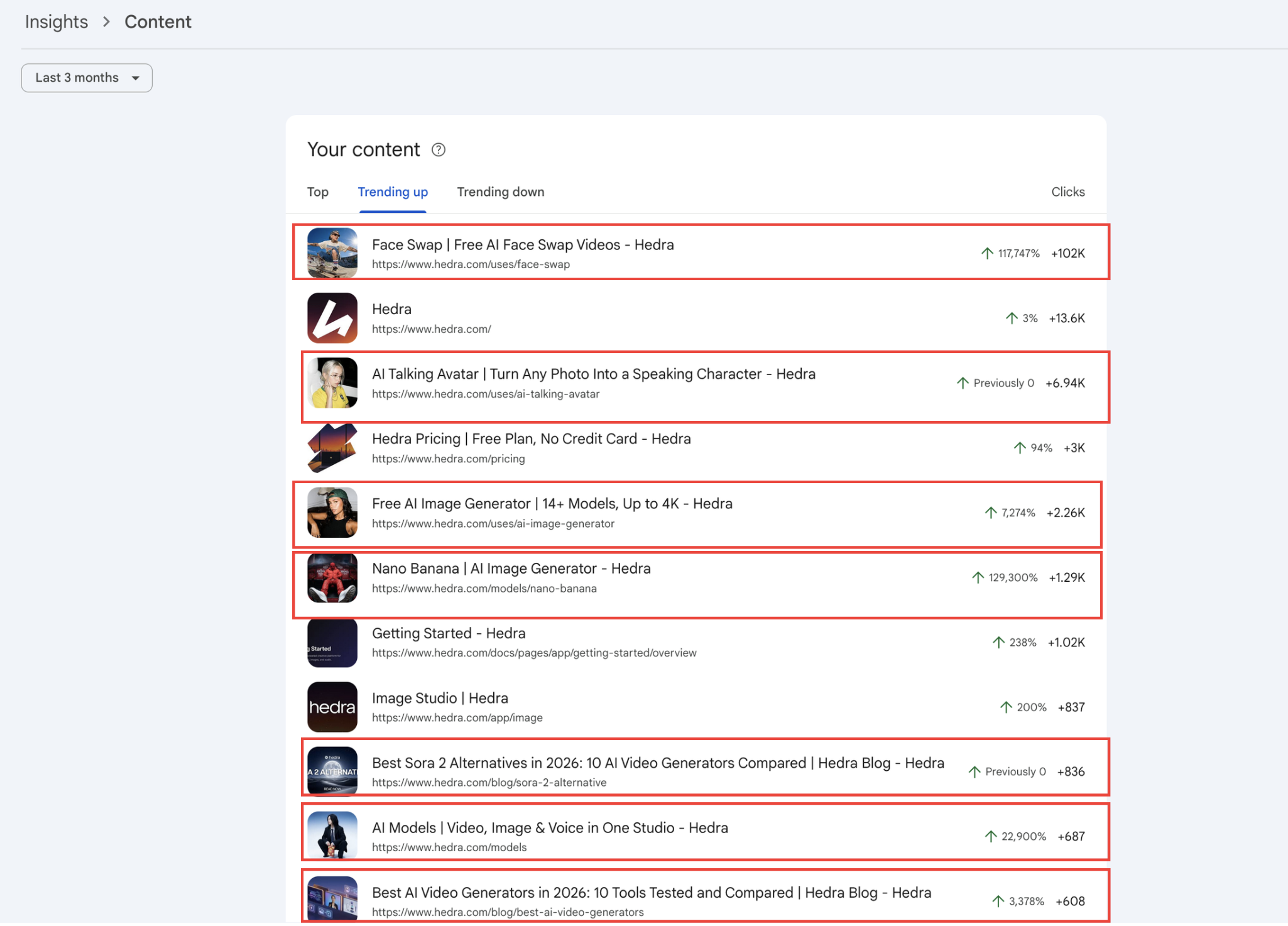
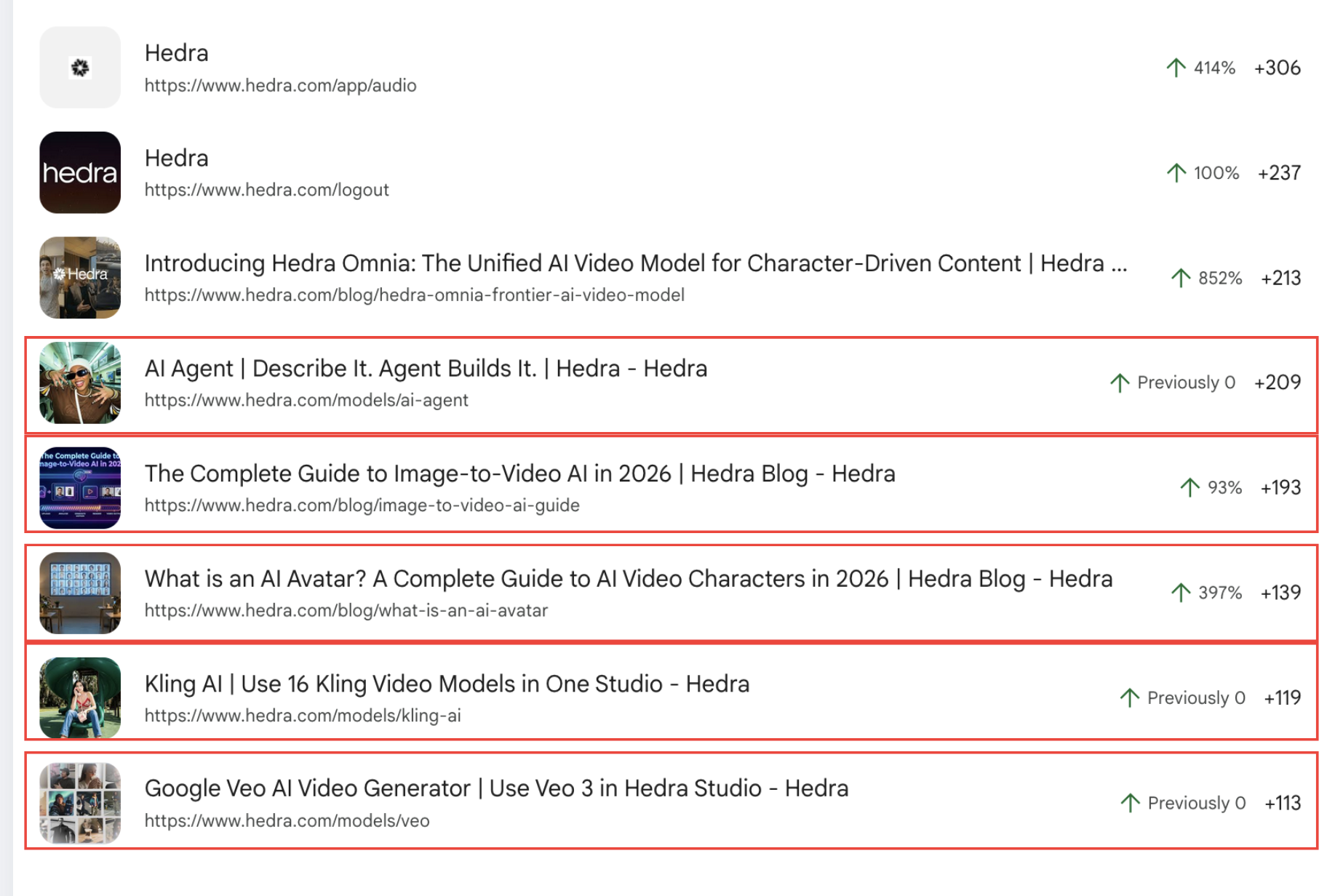
Four months in, the pages we built from zero are not slowing down. Over the last three months the face-swap page alone pulled another 102,000 clicks, and the talking-avatar page, nano-banana, the models hub, and both 2026 comparison guides all kept trending up in Hedra's Search Console, several of them from a starting point of zero.
The challenge
Hedra's organic traffic peaked in early 2025 and had eased off in the months before we started. The product was moving fast, but the site didn't yet have a structured library for the searches that drive purchase intent in AI video. That was the opening.
No dedicated bottom-of-funnel pages.
Hedra didn't yet have pages built for high-intent searches like "AI face swap tool," "AI talking avatar," or "AI image generator." Product-intent searchers landed on the homepage or a blog post that wasn't built to convert someone already in market.
Room to own comparison content for AI search.
Searchers comparing Manus, Canva, or Sora rarely found Hedra in the results. That comparison layer is the same one ChatGPT and Gemini pull from when they answer buying-intent questions, and it was open.
Content pitched at the whole category.
Existing content covered AI video broadly. It wasn't yet scoped tightly enough to stand out in a crowded space, or structured the way AI search engines need to cite it.
The site wasn't passing Core Web Vitals.
Hedra's pages were falling short on Core Web Vitals, Google's speed and stability checks that feed both rankings and the experience a buyer gets on arrival. Slow pages hold back every other piece of work on the site.
The approach
Blog posts are one of seven layers we ran for Hedra. The other six are what produced the revenue lift. We set the volume at 18 pages a month, the minimum needed to close the visibility gap against companies the size of Manus (originally Canva, before Hedra pivoted).
Keyword research and SERP analysis.
We mine the keyword landscape for the golden queries Hedra can realistically rank for, run a gap analysis against Canva, PhotoRoom, HeyGen, and Higgsfield to see what they rank for that Hedra doesn't, then break down the top 10 results on each query to find the angles those pages miss. The output is a full site architecture, mapped before a single page gets built, so every page has a place and a purpose.
Bottom-of-funnel landing pages.
Pages for people with active commercial and buying intent. We separate out the queries where the searcher is already shopping (things like "AI face swap tool" or "AI talking avatar generator") and build a dedicated page for each. Each page shows the product immediately and follows a clear path to sign up. This is the highest-converting page type in the library and the main reason organic purchaser rate grew more than sixfold.
Middle-of-funnel alternative pages.
Pages targeting people searching competitors (Manus, Canva, Sora) and converting them to Hedra. Also critical for AI SEO since ChatGPT and Gemini pull heavily from comparison content when answering "what should I use" style questions.
Backlink building.
Getting other sites to link to Hedra so Google trusts the domain more. Every page on the site ranks better as a knock-on effect, not just the pages we are actively building.
Internal linking.
Connecting related pages so Google understands the site structure and crawls the right ones first. Most of the lift on /models and /models/nano-banana came from internal linking, not from net-new content.
Technical SEO and indexation.
Fixing the plumbing so the rest of the work can rank. We improved page speed, fixed the robots file, and swapped a stale sitemap for one that updates itself whenever a page ships. We also find pages Google can't see properly and unblock them, so each one can compound traffic over time.
Blog content.
Long-tail visibility and AI search citation inventory. One layer of seven, scoped to comparison and explainer formats that ChatGPT and Gemini cite.
What we actually did
Several sub-systems shipped in parallel, all sitting on a technical foundation we fixed first. Each one points at a different searcher and a different surface (Google, ChatGPT, Gemini), but every page goes through the same scoping process before a writer touches it.
The /uses/ library.
Built /uses/face-swap, /uses/ai-talking-avatar, and /uses/ai-image-generator from zero. The face-swap page alone drove 64.3K sessions in the last 4 months. Every page targets one commercial query, shows the product above the fold, and converts on the same screen the searcher landed on. Each page started with the SERP, not the keyword. The top-ranking URLs were classified by page type to confirm a dedicated landing page would compete, then the keyword set was scoped tightly so no two pages overlapped. The scope decision happens before the outline, not after the draft.
The /models/ section.
Built the /models hub and individual model pages (/models/nano-banana and others) from zero. /models drove 562 sessions and /models/nano-banana drove 418, both starting at 0. Most of that lift came from internal linking work that gave Google clear signals about which pages to prioritize crawling, not from extra content.
The /alternatives/ library.
Built a dedicated /alternatives/ page for each tool people weigh Hedra against: /alternatives/runway, /alternatives/heygen, /alternatives/synthesia, /alternatives/canva, /alternatives/higgsfield, and more. These pages capture searchers actively comparing tools, and they are the same pages that fuel the ChatGPT and Gemini citation lift, because comparison content is exactly what AI search pulls from when someone asks "what should I use instead of X."
18 pages a month, scoped to specificity.
One keyword per page. Format chosen from the SERP. No drift across adjacent queries. We set 18 as the floor because that is the volume needed to close the visibility gap against companies the size of Manus inside a single quarter. Less than that and the compounding curve stretches by months, not weeks.
The technical foundation.
None of the content ranks if Google can't crawl the site or it loads slowly, so we fixed the plumbing alongside the pages. We improved page speed, fixed the robots file, and replaced a stale sitemap that didn't keep up with the site with one that regenerates itself whenever a page ships, so Google always sees the current structure.
Backlinks and domain trust.
Earned links from other sites back to Hedra so Google trusts the whole domain more. The knock-on effect lifts every page on the site, not just the ones we are actively building.
The results.
All figures compare Feb 1 to Jun 16, 2026 against the prior window (Sep 21, 2025 to Feb 3, 2026). Source: Hedra's GA4, with source / medium = google / organic for the Google numbers and chatgpt.com / referral and gemini.google.com / referral for the AI numbers (paid traffic excluded). Every win below is logged in a shared dashboard the Hedra team can see live, so the numbers are never a surprise at reporting time.
Organic Google revenue nearly tripled in the engagement window.
Buyers per organic visitor grew more than sixfold.
chatgpt.com referral revenue grew more than twelvefold in the engagement window.
gemini.google.com referral revenue nearly tripled in the engagement window.
| Channel (source / medium) | Purchaser rate | Purchases | Revenue |
|---|---|---|---|
| google / organic | +572.92% | +179.39% | +195.92% |
| chatgpt.com / referral | +287.68% | +933.33% | +1,149.7% |
| gemini.google.com / referral | +96.53% | +210.71% | +180.34% |