

SEO for hotels determines whether travelers find your property or your competitor down the street. Most hotel owners learn this the hard way.
They build something worth booking. They invest in the rooms, the service, the details that earn five-star reviews. Then they watch Booking.com and Expedia rank above their own website for their own hotel name. They watch inferior properties show up first for "boutique hotel [their city]." They wonder why guests who would love their property never discover it exists.
The answer is not quality. The answer is visibility.
—————————
The global hotel booking market hit $523 billion in 2024 (Navan, 2025). That is half a trillion dollars flowing through an industry where visibility determines survival.
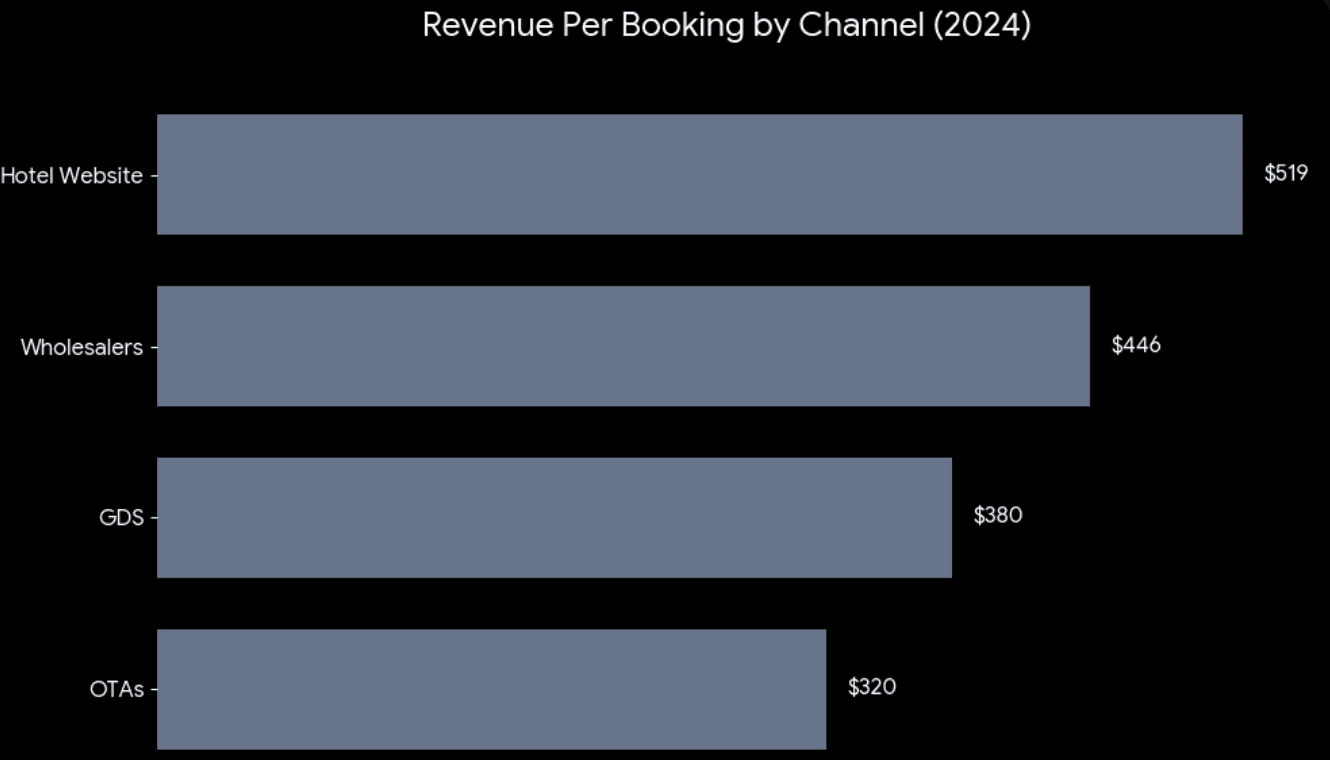
Here is what most hotel owners do not realize: direct bookings through your own website generate an average of $519 per reservation. Bookings through OTAs like Booking.com and Expedia? Just $320 (SiteMinder, 2025). That is a 60% revenue premium sitting on the table for hotels that know how to capture organic search traffic.
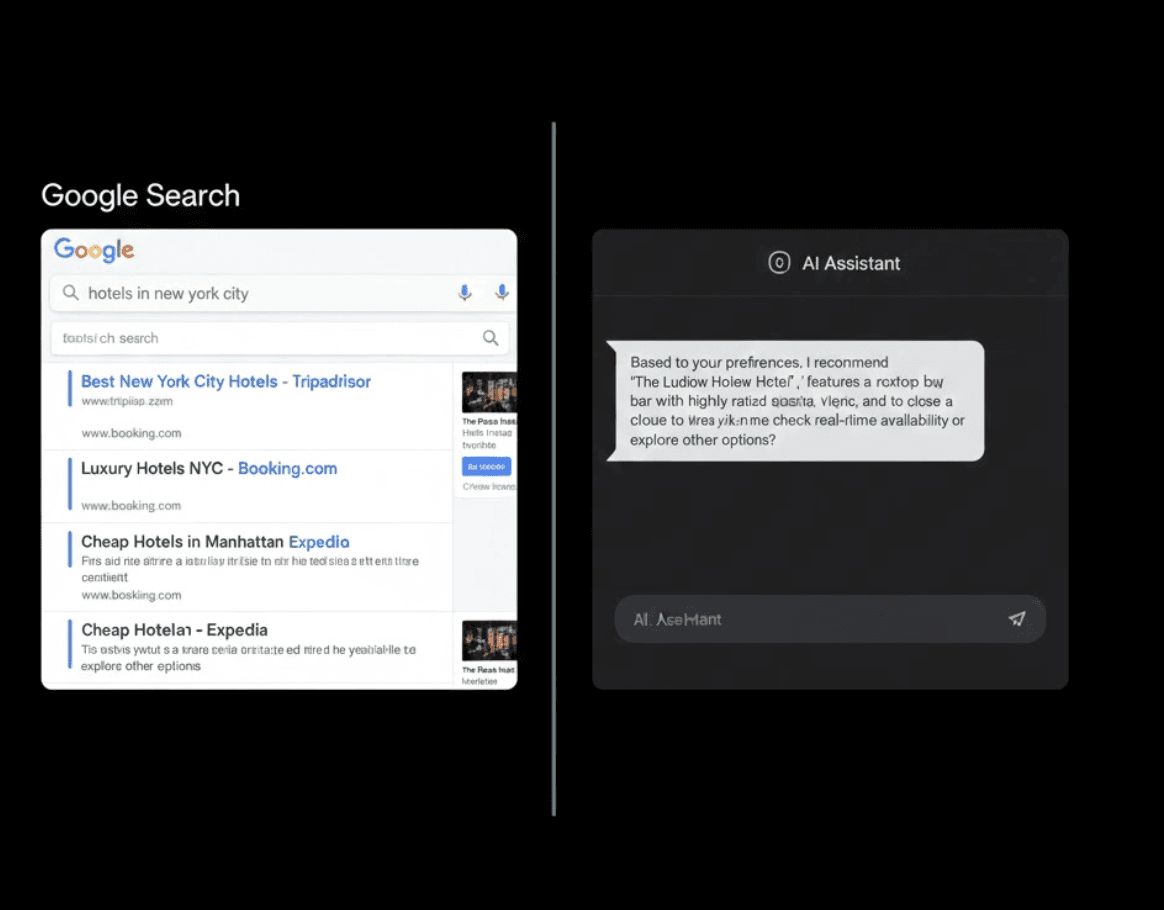
But 2026 is different from previous years. Travelers are no longer just typing "hotels in Miami" into Google. They are asking ChatGPT for the best boutique hotel with a rooftop pool. They are using Perplexity to compare options. They are getting answers from Google's AI Overviews before ever clicking a link.
SEO for hotels now means being visible across traditional search results AND AI-powered platforms. The properties that master both will capture more direct bookings, slash OTA commission costs, and build competitive advantages that compound over time.
This guide breaks down exactly how to make that happen.
Why Hotels Cannot Afford to Ignore SEO in 2026
Before diving into tactics, you need to understand what is at stake. The economics of hotel distribution have shifted dramatically, and properties without strong organic visibility are hemorrhaging revenue to intermediaries.
The Direct Booking Opportunity Most Hotels Are Missing
Every booking through an OTA costs your hotel money. Commission rates typically range from 15-30% depending on the platform (Cloudbeds, 2025). On a $200 room night, that is $30 to $60 going to a middleman instead of your bottom line.
The revenue gap between direct and OTA bookings is substantial:
Booking Channel | Average Revenue Per Booking | Commission Cost |
|---|---|---|
Hotel Website (Direct) | $519 | 0-3.5% |
OTAs (Booking.com, Expedia) | $320 | 15-30% |
GDS (Global Distribution Systems) | $380 | 10-15% |
Wholesalers/Tour Operators | $446 | Varies |
Data: (SiteMinder, 2025)
Direct bookings outperform every other channel. Guests booking directly choose higher-value rooms, stay longer, and add more extras (SiteMinder, 2025). Revenue per direct booking grew 8.5% year-over-year in 2024, the fastest growth among all channels.
The industry is taking notice. By 2030, direct digital channels are projected to surpass OTAs as the primary booking source, generating $409 billion compared to $333 billion from OTAs (Skift Research, 2025). Hotels investing in SEO now are positioning themselves to capture this shift.
How Travelers Actually Find Hotels Today
Understanding where your guests start their search reveals why SEO matters so much.
Search engines remain the top resource for travel planning. When asked how they research trips, 46% of travelers cited search engines as their primary tool, ahead of travel review websites (36%), personal recommendations (35%), and hotel websites directly (31%) (Skift, 2025).
The numbers paint a clear picture:
72% of travelers prefer booking online versus just 12% through traditional travel agencies (OysterLink, 2025)
72% of hotel bookings happen within 48 hours of a Google search (MARA, 2025)
83% of travelers research trips on their mobile phones (hotelagio, 2025)
80% of travelers visit an OTA at some point before booking, even if they ultimately book elsewhere (TravelWeekly, 2025)
That last statistic is critical. Travelers use OTAs to discover hotels, then often search the hotel name directly to find better rates or perks. This "billboard effect" means strong SEO captures guests who discovered you elsewhere but want to book direct.
The Rise of AI Search and What It Means for Hotels
Here is where 2026 differs from every year before it.
Over 22% of global travelers have already used ChatGPT or similar AI chatbots to plan travel (Simple Flying, 2025). Among frequent travelers, that number exceeds 25% (Catala Consulting, 2025). AI search adoption has grown 3-4x since 2023, with analysts predicting another 10-15x increase in the coming years (Nelios, 2025).
Meanwhile, nearly 60% of Google searches now result in zero clicks (SparkToro, 2025). Users get their answers directly from AI Overviews, featured snippets, and knowledge panels without ever visiting a website.
The implications for hotels are significant:
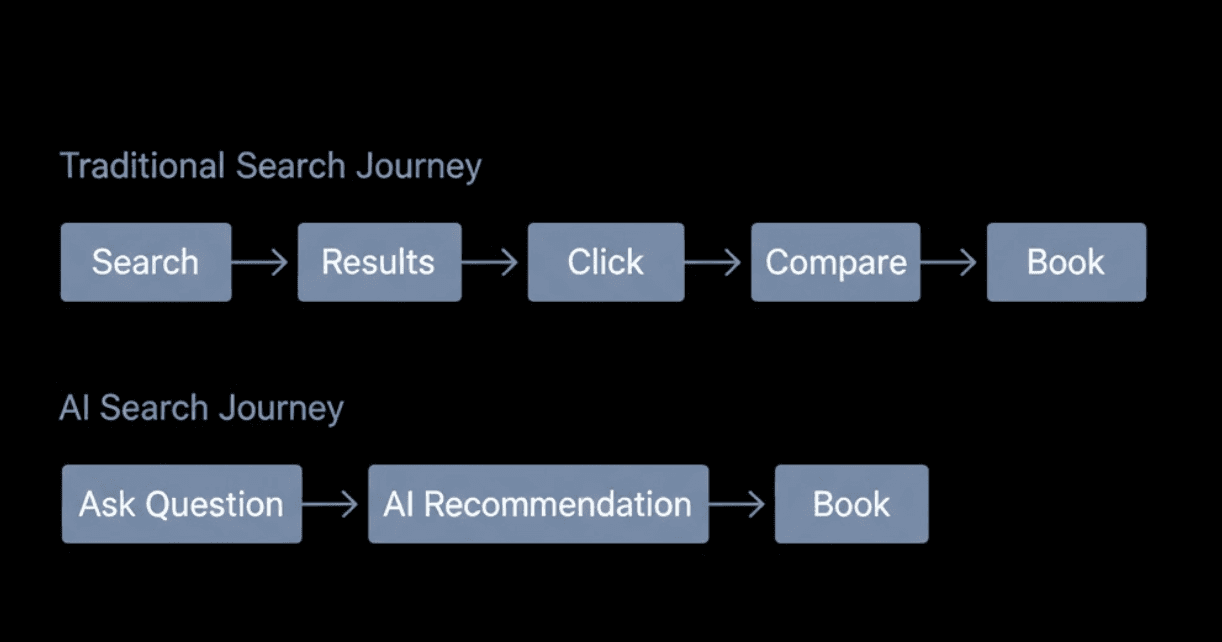
Traditional search: User types "hotels in Seattle" → Sees list of results → Clicks through to compare → Eventually books
AI search: User asks "What is the best boutique hotel in Seattle near Pike Place Market with a rooftop bar under $300?" → AI provides direct recommendation with reasoning → User books recommended property
If your hotel is not appearing in AI-generated recommendations, you are invisible to a growing segment of travelers. This is not a future concern. It is happening now.
Looking for a professional agency that specializes in hotel SEO services? Reach out to us. We are here to help.
The Core Components of Hotel SEO
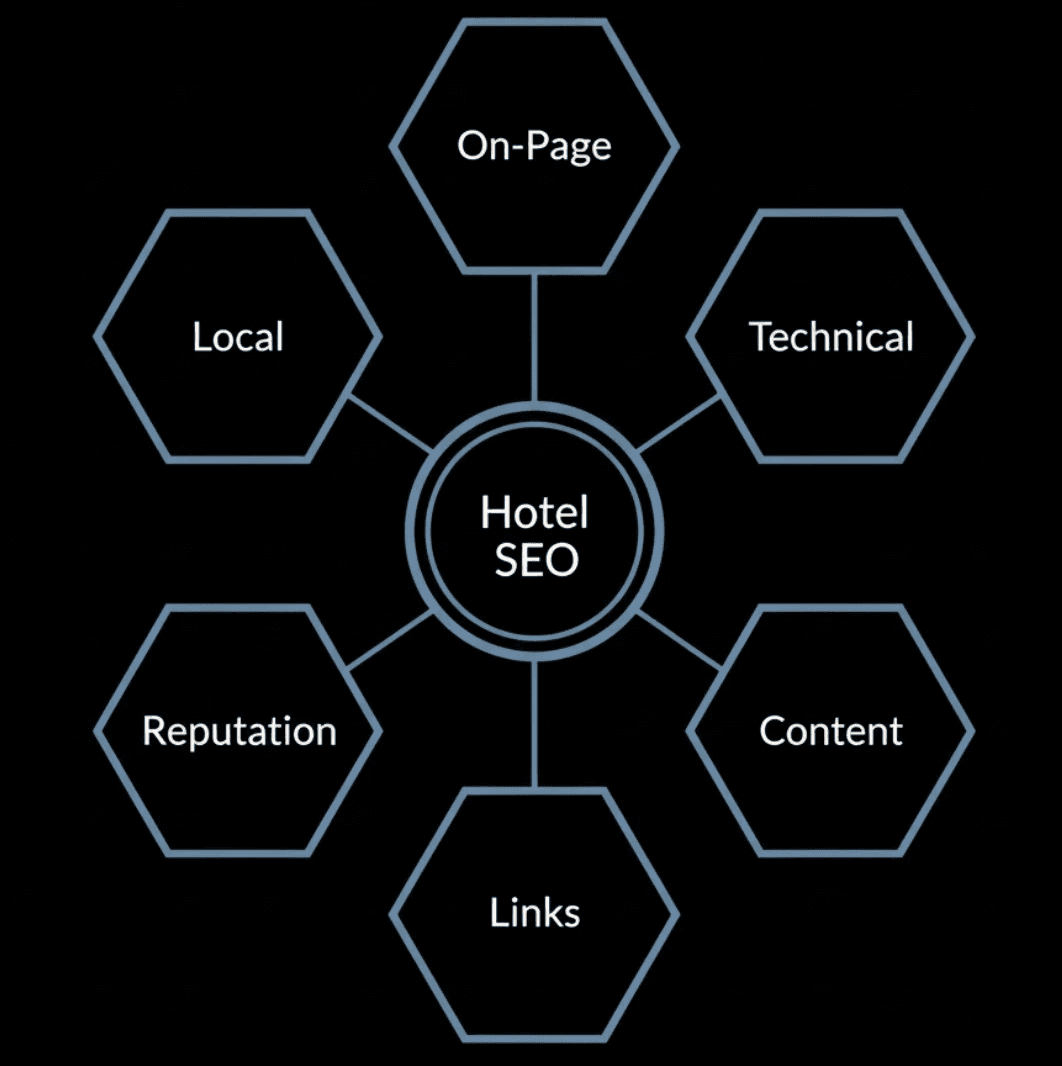
Hotel SEO is not one tactic. It is a system of interconnected elements that work together to build visibility. Neglect any component and the entire system underperforms.
On-Page SEO: Making Your Website Speak Google's Language
On-page SEO ensures search engines understand what your hotel offers and who should find it. Every page on your website needs optimization.
Keyword Research for Hotels
Hotel searches combine location, property type, amenities, and intent. Your keyword strategy should capture all variations your ideal guests might use:
Keyword Type | Example | Search Intent |
|---|---|---|
Location + Property Type | "boutique hotel downtown Seattle" | Commercial |
Location + Amenity | "Seattle hotel with rooftop pool" | Commercial |
Location + Audience | "family-friendly hotel Seattle" | Commercial |
Informational | "best area to stay in Seattle" | Research |
Branded | "[Your Hotel Name] reviews" | Decision |
Focus on long-tail keywords with clear intent. "Hotel Seattle" is highly competitive and vague. "Pet-friendly hotel near Pike Place Market" has clearer intent and less competition.
Title Tags and Meta Descriptions
Every page needs a unique title tag under 60 characters that includes your primary keyword. For your homepage, this might be:
Boutique Hotel Downtown Seattle | [Hotel Name]
Meta descriptions should be 150-160 characters and compel clicks. Include your location, a key differentiator, and a reason to book direct:
Award-winning boutique hotel steps from Pike Place Market. Rooftop bar, free breakfast, best rate guarantee when you book direct.
Content Optimization
Your room pages, amenity descriptions, and location content should be unique. Do not copy descriptions from OTAs. Search engines penalize duplicate content, and identical descriptions across platforms give users no reason to visit your site directly.
Write for humans first, but include relevant keywords naturally. A room description should mention the room type, bed configuration, view, amenities, and size in a way that helps guests visualize their stay.
Technical SEO: The Foundation That Makes Everything Work
Technical SEO ensures search engines can crawl, index, and understand your website. Without it, even the best content stays invisible.
Site Speed
Speed directly impacts both rankings and bookings. 53% of mobile users abandon sites that take longer than 3 seconds to load (Google, 2024). For hotels, a slow booking engine means lost reservations.
Priority fixes include:
Compress images without sacrificing quality
Enable browser caching
Minimize code (CSS, JavaScript)
Use a content delivery network (CDN)
Choose fast, reliable hosting
Test your speed with Google PageSpeed Insights and aim for Core Web Vitals scores in the green.
Mobile Optimization
Mobile devices account for 60% of hotel bookings (Hotel Benchmark, 2024), yet only half of mobile browsers complete their reservations. The gap often comes from poor mobile experiences.
Your booking engine must work flawlessly on phones. Buttons should be large enough to tap. Forms should minimize typing. The path from landing page to confirmed booking should take as few steps as possible.
Site Architecture
Organize your website logically:
Homepage → Room Types → Individual Room Pages
Homepage → Amenities → Specific Amenity Pages
Homepage → Location → Area Guides
Homepage → Offers → Specific Packages
Use descriptive URLs. /rooms/deluxe-king-ocean-view tells users and search engines what to expect. /page?id=4532 tells them nothing.
Crawlability
Submit an XML sitemap through Google Search Console. Check for crawl errors regularly. Fix broken links promptly. Ensure your robots.txt file is not accidentally blocking important pages.
Local SEO: Winning the "Hotels Near Me" Search
For hotels, local SEO is not optional. It is arguably the most important component of your entire strategy.
Local search drives action. 88% of consumers who conduct a local search on their smartphone visit or call a business within a day (SeoProfy, 2024). For hotels, that visit is often a booking.
Google Business Profile Optimization
Your Google Business Profile (GBP) is your hotel's most valuable digital asset for local visibility. When travelers search "hotels near me" or "hotels in [city]," GBP listings appear prominently in the map pack.
42% of local searchers click on map pack results (Backlinko, 2024). Hotels not appearing there lose nearly half their potential local traffic.
Optimize your GBP by:
Selecting the correct primary category (Hotel, Boutique Hotel, Resort, etc.)
Adding all relevant secondary categories
Completing every attribute (amenities, accessibility, payment options)
Uploading high-quality photos monthly
Posting updates about events, offers, and property news
Responding to every review promptly
Answering questions in the Q&A section
Customers are 2.7x more likely to trust a business with a complete Google Business Profile (SeoProfy, 2024). Incomplete profiles signal neglect.
NAP Consistency
NAP stands for Name, Address, and Phone number. This information must be identical everywhere your hotel appears online.
Inconsistencies confuse search engines. "123 Main Street" on your website, "123 Main St." on TripAdvisor, and "123 Main St, Suite 100" on Yelp signals to Google that these might be different businesses.
Audit your listings and standardize everything. Use the exact format from your GBP as the template.
Local Citations
Citations are mentions of your hotel on directories, travel sites, and local business listings. Important citation sources for hotels include:
Category | Examples |
|---|---|
Travel Directories | TripAdvisor, Yelp, Kayak |
OTA Listings | Booking.com, Expedia, Hotels.com |
Map Services | Apple Maps, Bing Places, Waze |
Local Business | Chamber of Commerce, tourism boards |
Industry Specific | AAA, Forbes Travel Guide |
Each citation reinforces your hotel's legitimacy and location relevance.
Content Marketing: Building Authority That Attracts Guests
Travelers consume an average of 303 minutes of travel content in the 45 days before booking (Navan, 2025). That is over five hours of research where your hotel could be the trusted resource providing answers.
Destination Guides
Create comprehensive guides about your location. What should visitors see? Where should they eat? How do they get around? This content ranks for informational queries and positions your hotel as the local expert.
A guide titled "48 Hours in Seattle: A Local's Itinerary" attracts travelers in the research phase. Include a subtle mention of your hotel's proximity to highlighted attractions.
FAQ Content
Answer every question guests might have before booking:
What time is check-in/check-out?
Is parking available? What does it cost?
Are pets allowed?
What is nearby?
Is breakfast included?
FAQ content serves two purposes. It ranks for long-tail queries and reduces friction in the booking process.
Seasonal and Event Content
Create content around local events, holidays, and seasons. "Where to Watch 4th of July Fireworks in Seattle" or "Seattle Holiday Markets: Your Complete Guide" captures seasonal search traffic and showcases your property as the ideal home base.
Content Type | Funnel Stage | Example |
|---|---|---|
Destination Guides | Awareness | "Best Neighborhoods in Seattle" |
Activity Guides | Consideration | "Rainy Day Activities Near Downtown Seattle" |
Comparison Content | Decision | "Why Book Direct vs Through an OTA" |
FAQ/Policy | Booking | "Check-in Procedures and What to Expect" |
Hotels aren't the only travel businesses that benefit from SEO. Tour operators and travel agencies face similar challenges with OTA dominance. Learn more about SEO for travel agencies.
Link Building: Earning Authority in the Hospitality Space
Backlinks from other websites signal to search engines that your hotel is trustworthy and authoritative. Quality matters far more than quantity.
Local Partnership Opportunities
Your community offers natural link building opportunities:
Tourism boards: Most have member directories with links
Local attractions: Partner for cross-promotion
Event venues: If you host wedding blocks or conference attendees
Restaurants and businesses: "Where to stay" recommendations
Travel Publications
Guest posts, expert commentary, and destination features in travel publications build authority and drive referral traffic. Pitch unique angles: your chef's perspective on local cuisine, your concierge's hidden gem recommendations, or data on travel trends you have observed.
Unlinked Mentions
Search for your hotel name online. You will likely find mentions on blogs, news articles, and travel sites that do not link to your website. A polite outreach email often converts these to backlinks.
Reputation Management: Reviews as an SEO Signal
Reviews influence both rankings and conversions. 81% of travelers always read reviews before booking a hotel (MARA, 2025). More importantly, 88% of travelers filter hotels by ratings, eliminating properties below three stars from consideration (TravelBoom, 2025).
The revenue impact is quantifiable. A 1-star increase in ratings can contribute to a 5-9% increase in revenue (Harvard Business School, 2025).
Review Generation
Travelers read 6-12 reviews before choosing a hotel (TripAdvisor, 2025). Volume matters alongside rating. Implement systems to encourage reviews:
Send post-stay emails with direct links to review platforms
Train staff to mention reviews at checkout
Make the process easy with QR codes in rooms or at reception
Never incentivize reviews (this violates platform policies)
In my experience working with hospitality clients, review velocity often stalls because staff do not have clear processes. When we worked with Aetherhaus, we created staff training workflows for requesting feedback at natural touchpoints. Within six weeks, they gained over 50 new reviews averaging 4.5 stars, which directly boosted their local pack visibility.
Review Response
Responding to reviews signals engagement to both search engines and potential guests. Thank positive reviewers specifically. Address negative reviews professionally, acknowledging concerns and explaining how you are addressing them.
92% of travelers trust user-generated content over brand advertising (CrowdRiff, 2024). Your responses are part of that content.
Schema Markup for Hotels: The Technical Edge Most Properties Miss
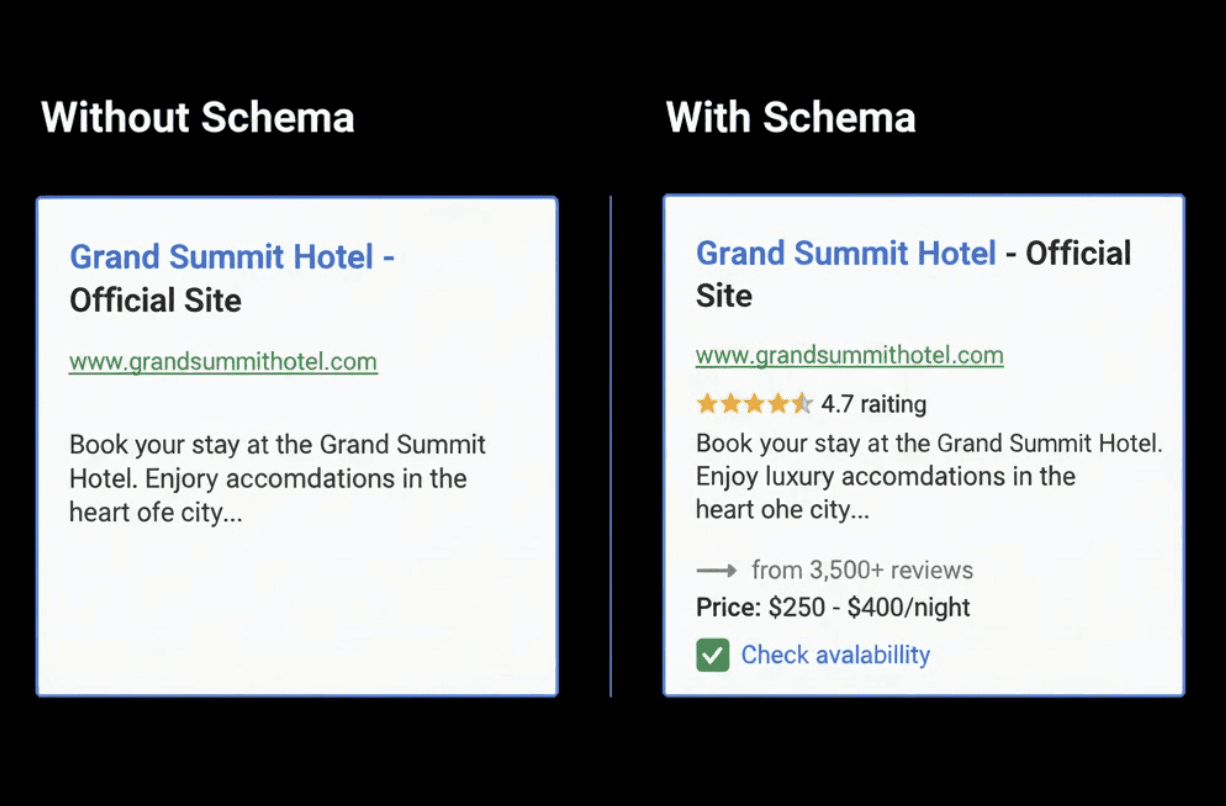
Schema markup is code that helps search engines understand your content. For hotels, it enables rich results that display ratings, pricing, and availability directly in search results.
Rich results from schema markup can increase click-through rates by up to 30% (O'Rourke Hospitality, 2025). Yet most hotels either have no schema or use generic templates that miss hotel-specific opportunities.
Why Schema Matters More Than Ever
Search engines and AI systems use structured data to understand what your hotel offers. Without schema, they are guessing. With it, you are telling them exactly what to display.
Schema also powers voice search. When someone asks their smart speaker "What hotels near me have a pool?", the answer comes from structured data. 76% of smart speaker users conduct local voice searches weekly (Keywords Everywhere, 2025). Hotels with proper schema appear in these results. Hotels without it do not.
Essential Schema Types for Hotels
Schema Type | What It Enables |
|---|---|
Hotel | Property details, star rating, amenities |
LocalBusiness | NAP, hours, geo-coordinates |
AggregateRating | Star ratings displayed in search |
Review | Individual review snippets |
FAQPage | FAQ rich results for common questions |
Offer | Room rates and availability |
Event | On-site events and packages |
How to Implement Hotel Schema
The recommended format is JSON-LD, placed in your website's header. Here is a simplified example:
Implementation options include:
Manual coding: Add JSON-LD directly to your site's HTML
CMS plugins: Yoast SEO, RankMath, or Schema Pro for WordPress
Google Tag Manager: Deploy without touching site code
Booking engine integration: Some platforms add schema automatically
Always test your implementation using Google's Rich Results Test before going live.
AI Search Optimization (GEO): The 2026 Frontier
Traditional SEO gets you ranking on Google. Generative Engine Optimization (GEO) gets you recommended by ChatGPT, Perplexity, Google's AI Overviews, and other AI platforms.
This is not theoretical. Travelers are already asking AI systems questions like:
"What is the best hotel in Miami for a bachelorette party?"
"Recommend a quiet hotel in Tokyo near Shibuya with good reviews"
"Where should I stay in Barcelona if I want to be near the beach but also close to restaurants?"
If your hotel is not appearing in these responses, you are invisible to a growing segment of your potential guests.
How AI Search Engines Find and Recommend Hotels
AI systems do not crawl the web in real-time for every query. They rely on:
Training data: Content indexed when the model was trained
Real-time retrieval: Some systems (like Perplexity) search the web live
Structured data: Schema markup and clear content organization
Authority signals: Brand mentions, backlinks, citations across the web
Review aggregation: Sentiment and themes from review platforms
Being mentioned on authoritative sites matters. If travel publications, listicles, and industry resources cite your hotel, AI systems are more likely to recommend it.
Practical Steps to Optimize for AI Search
Structure content around questions
Create dedicated pages or sections answering specific traveler queries:
"Is [Hotel Name] good for families?"
"What is within walking distance of [Hotel Name]?"
"Does [Hotel Name] have airport shuttle?"
Build FAQ sections with concise answers
AI systems love extracting clear, direct answers. Write FAQ responses in 40-60 words that fully address the question without fluff.
Earn mentions on listicles and directories
"Best hotels in [city]" articles are prime AI training material. Reach out to travel bloggers and publications for inclusion. Ensure your presence on relevant "best of" lists.
Monitor AI platforms
Periodically test queries about your hotel and competitors on ChatGPT, Perplexity, and Google's AI features. Note where you appear and where you are absent. This reveals gaps in your visibility.
Optimization Type | Traditional SEO Focus | GEO Focus |
|---|---|---|
Keywords | Search volume, rankings | Conversational queries, questions |
Content | Page optimization | Extractable answers, clear structure |
Links | Domain authority | Brand mentions, citations |
Technical | Crawlability, speed | Schema depth, data consistency |
Success Metric | Rankings, traffic | AI citations, brand mentions |
Measuring Hotel SEO Success
SEO without measurement is guesswork. Tracking the right metrics reveals what is working, what needs adjustment, and whether your investment is generating returns.
Key Performance Indicators for Hotel SEO
Visibility Metrics
Keyword rankings for target terms (branded and non-branded)
Local pack appearances and position
Impressions in Google Search Console
AI search citations (manual monitoring)
Traffic Metrics
Organic sessions (total and by landing page)
Mobile vs. desktop breakdown
Geographic distribution of visitors
Pages per session and bounce rate
Conversion Metrics
Booking engine clicks from organic traffic
Direct booking conversion rate
Phone calls from organic (track with call tracking)
Email signups and inquiry form submissions
Revenue Metrics
Revenue attributed to organic traffic
Cost per acquisition compared to OTA and paid channels
Direct booking percentage growth over time
Average booking value from organic visitors
Tools for Tracking Hotel SEO Performance
Google Search Console (Free) Tracks which queries bring impressions and clicks, identifies indexing issues, and shows your average position for target keywords.
Google Analytics 4 (Free) Measures traffic, user behavior, and conversions. Set up goals to track booking completions from organic traffic.
Google Business Profile Insights (Free) Shows how users find your GBP listing, what actions they take, and how your visibility changes over time.
Rank Tracking Software (Paid) Tools like SEMrush, Ahrefs, or Moz track keyword positions over time and monitor competitor movements.
AI Visibility Monitoring (Emerging) New tools track brand mentions across AI platforms. Manual testing (asking AI systems about your hotel) remains useful.
Realistic Timelines and Expectations
SEO is not instant. Anyone promising page-one rankings in 30 days is either lying or planning to use tactics that will eventually backfire.
Month 1-2: Foundation work. Technical fixes, GBP optimization, schema implementation, initial content improvements. Minimal ranking changes expected.
Month 3-4: Content expansion, local citation building, review generation systems. Early ranking movements for less competitive terms.
Month 5-6: Authority building through link acquisition, continued content development. Measurable ranking improvements for target keywords.
Month 6-12: Compounding returns. Traffic growth accelerates as authority builds. Revenue impact becomes clearly measurable.
Beyond 12 months: Sustained competitive advantage. Continued optimization maintains and extends gains.
The key difference between SEO and paid advertising: when you stop paying for ads, traffic stops immediately. SEO benefits persist and compound. A page ranking well today can drive bookings for years with minimal ongoing investment.
DIY vs Professional Hotel SEO: Making the Right Choice
Not every hotel needs an agency. But not every hotel should attempt SEO alone. The right choice depends on your situation.
When DIY Hotel SEO Makes Sense
Managing SEO internally can work if:
You have dedicated marketing staff with SEO knowledge or time to learn
Your market is not highly competitive (smaller destination, niche property type)
You can commit 10-20 hours weekly to ongoing optimization
Budget constraints make agency fees prohibitive
You are comfortable with slower initial progress while building expertise
DIY Limitations
The learning curve delays results. Technical issues often require expertise that takes years to develop. Link building and GEO require relationships and strategies that agencies have built over time.
Most critically, there is opportunity cost. Hours spent learning and executing SEO are hours not spent on guest experience, operations, or other revenue-generating activities.
When Professional Help Delivers Better ROI
Working with SEO specialists makes sense when:
You operate in a competitive market (major city, popular tourist destination)
OTA commissions are consuming significant revenue you want to recapture
You lack in-house SEO expertise and hiring is not practical
You want faster, more predictable results
AI search optimization is a priority and you need specialized knowledge
Your time is better spent on hotel operations than marketing execution
What to Look for in a Hotel SEO Partner
Not all agencies are equal. Look for:
Hospitality experience: Understanding of hotel booking cycles, seasonal patterns, and industry-specific challenges
Documented results: Case studies with measurable outcomes, not just rankings but revenue impact
Technical capabilities: Ability to implement recommendations, not just provide reports
GEO expertise: Understanding of AI search optimization, not just traditional SEO
Transparent reporting: Clear communication about what is being done and why
Realistic expectations: Honest timelines and no guarantees of specific rankings
At The 66th, we have helped hospitality clients like Aetherhaus achieve 686% organic traffic growth and 50% revenue increases within months by combining foundational SEO with AI search optimization. The difference is execution. We do not just hand you a strategy document. We implement it.
Frequently Asked Questions
How long does SEO take to work for hotels?
Most hotels see measurable ranking improvements within 3-6 months, with significant traffic and revenue impact by month 6-12. Competitive markets may take longer. Unlike paid advertising, SEO results compound over time rather than disappearing when you stop investing.
Is SEO better than paid ads for hotels?
Both serve different purposes. SEO builds lasting visibility with lower long-term acquisition costs. Paid ads provide immediate visibility but stop when spending stops. The most effective strategies use both: paid ads for immediate needs and seasonal pushes, SEO for sustainable direct booking growth.
How much does hotel SEO cost?
Costs vary based on market competitiveness and scope. DIY requires significant time investment (10-20+ hours weekly). Professional services typically range from $3,000 to $15,000+ monthly depending on property size, market competition, and service scope.
Can small hotels compete with big chains in SEO?
Yes. Local SEO and niche targeting allow boutique and independent hotels to outrank chains for specific searches. Large chains often have slower, less agile marketing operations and generic content. Independents can create highly relevant, locally-focused content that resonates better with specific traveler segments.
What is the most important SEO factor for hotels?
No single factor dominates. Hotels with strong SEO combine technical health, local optimization, quality content, consistent reviews, and increasingly, AI visibility. Neglecting any component weakens the entire system. Start with technical foundations and local SEO, then build content and authority.
How do I get my hotel to show up in ChatGPT?
AI visibility requires strong web presence, consistent brand mentions across authoritative sources, well-structured content with clear answers to common questions, and active review profiles. This practice is called Generative Engine Optimization (GEO). It builds on traditional SEO but requires additional focus on content structure and third-party citations.
Key Takeaways
SEO for hotels in 2026 requires visibility across both traditional search engines and AI platforms. The fundamentals remain important, but the game has expanded.
The opportunity is significant. Direct bookings generate 60%+ more revenue than OTAs. Hotels capturing organic search traffic keep more of every dollar.
The core components work together. On-page optimization, technical SEO, local search, content marketing, link building, and reputation management form an interconnected system. Neglecting any piece weakens the whole.
Schema markup provides a technical edge. Structured data enables rich results that increase click-through rates by up to 30% and powers voice search visibility.
AI search is the new frontier. Over 22% of travelers already use AI for trip planning. Hotels optimizing for ChatGPT, Perplexity, and AI Overviews gain first-mover advantage.
Results take time but compound. Unlike paid advertising, SEO benefits persist and grow. A well-optimized page can drive bookings for years.
Execution matters more than strategy alone. Knowing what to do is different from doing it consistently and correctly.
For hotels serious about reducing OTA dependency and capturing more direct bookings, investing in comprehensive SEO is not optional. The properties optimizing now will dominate both traditional and AI search results for years to come.